
Training modules
Training module: “Pukure Mach Chash: Katha O Kahini”
“What’s the use of another training module? Numerous manuals are produced and distributed to us as a gimmick of capacity building. But seldom is our knowledge documented and our voices heard!” This fiery remark from a community representative from Bangladesh left a lasting impression on the ENGAGE team, who then felt the need to produce materials that are meaningful to people on the ground. SOR4D-funded ENGAGE4Sundarbans and its precursor Swissnex-funded CLOC-K2A provided the opportunity to experiment with visual storytelling as a method for coproducing an inland fishing training module that could be widely accepted by small-scale pond fishers and others.
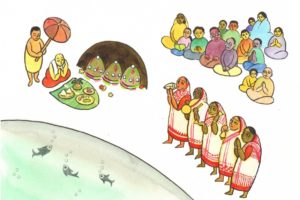
Pukure Mach Chash: Katha O Kahini is a visually re/told fisheries manual that stitches together facts and figures from the deployment of an array of qualitative methods (adda, focus group discussions, key informant interviews and knowledge co-production exercises), involving local fishers, panchayat members, fisheries scientists and academics. The visual language was co-designed. The women fishers rejected early colour choices as “too formal, too detached and too urban”, and asked for the greens, reds and yellows of their own world, along with local motifs and corrections to how water and figures are drawn. In this way, vernacular and scientific knowledge sit on the same page, and the community’s visual culture becomes a way of doing science, made by visual artist Pratyasha Nath and the storyteller Jenia Mukherjee.
Practice-based (bilingual) training modules
The transdisciplinary Indian team realized the significance of developing knowledge outputs in the form of practice-based (bilingual) training modules in inland fisheries with infographics and sketches, accommodating inputs from fishers and cross-feeding with (mainstream) scientific information and standard practices.