Aims: The workshop aimed to cultivate cross-learning within diverse knowledge systems, deepen partnerships, and identify pathways for scaling commons-based agroecological practices across the region.
Objectives: Four major objectives are -a) Strengthening the canal-fishing experimentation, b) Connecting government programmes with local initiatives, c) Enhancing more-than-fishing livelihood practices through agroecological processing and marketing and d) Advancing transformation through the scaling initiative.
Methodologies: The participatory approach adopted. The mutually designed methodologies are- i) Designing the in-situ framework, ii) Participants and rationale for participation, iii) Participatory mapping and co-learning and iv) Reflexive analysis.
In-Situ Workshop: The July workshop is best understood not as a periodic review of the Collective Canal Fishing Experimentation (CCFE), but as a moment in which the project paused to ask what had been learned, whose knowledge had shaped the work, what remained uncertain, and what kinds of collaboration might be useful next. The workshop brought community mobilisers and households into conversation with scientists, practitioners, development actors, government officials and researchers. More importantly, it created a practical setting in which these different positions could meet around a common concern: how canal fishing and related agroecological activities might contribute to livelihood security while remaining socially and ecologically viable. The workshop also marked the beginning of a set of plans of Strengthening Water Governance (SWAG) under the Transformation Accelerating Grant (TAG) of the SOR4D programme. The broader goal of this next phase is to support the transition towards climate-resilient livelihoods by building on local governance and collective capacities, strengthening access to markets and institutional support, and exploring possibilities for wider uptake of commons-based agroecological practices. In this sense, the July 2026 workshop offered a vital space in which experimentation, reflection, collaboration, and action continue to shape one another.
Workshop outputs: The major outputs from this workshop are -a) detailed project report, b) participatory methodological output and c) an expert profiling. These deliverables will help consolidate the insights generated during the workshop and provide a structured basis for subsequent project activities. In addition, the team discussed a brief yet comprehensive immediate action plan, outlining the key follow-up activities, responsibilities, and priorities emerging from the three-day workshop. Thus provided an important opportunity to move from discussion and reflection towards documentation, coordination, and a clear roadmap for the next phase of the project.
Way Forward / Action plans: Four major future plans emerged from this workshop – (i) Plan for operationalization: Develop a preliminary production layout in August and initiate the process of seeking necessary approvals towards setting up the mini processing unit of agro-ecological products. (ii) Knowledge brochure: Prepare a brochure on vermicomposting as one of the project’s tangible knowledge outputs and training from UBKV / North Bengal Agriculture University. (iii) Formation of a new enterprise-focused group: In addition to the five existing canal-fishing experimentation groups, form a separate group focused on enterprise development during the scaling-out phase. (iv) Events on value chain for five agroecological products: Conduct training/workshop on the market value chains of the five agroecological products- organic honey, blue tea, hibiscus tea, lentil dumplings and vermi compost.
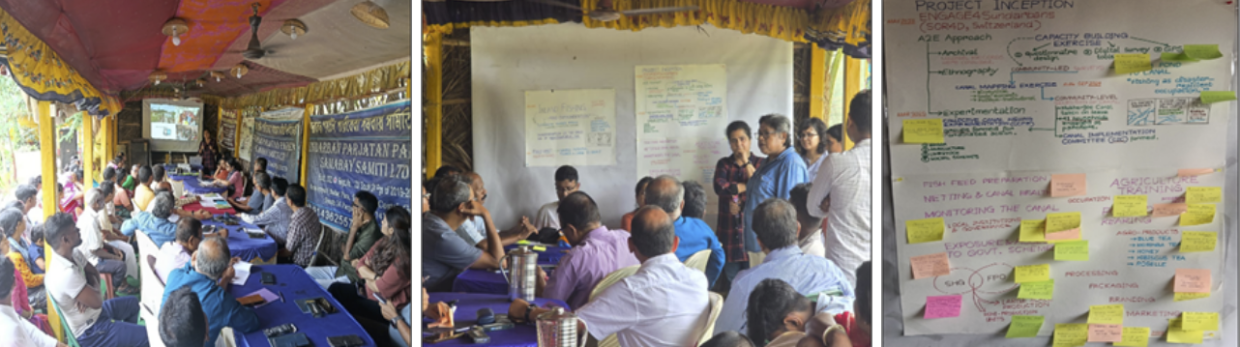
Photos: In-situ workshop at Kumirmari, Indian Sundarbans, 24-26 July 2026